Pixels to Pavement: The Sim Racers Who Are Rewriting the Road Into Professional Motorsports
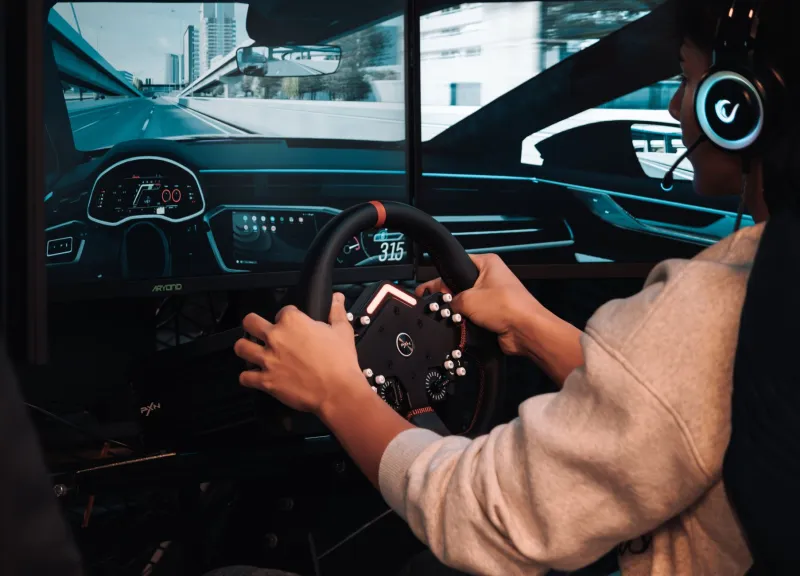
Darius Webb grew up in a two-bedroom apartment in Memphis with no garage, no family racing history, and absolutely no budget for karts. What he had was a $200 racing wheel clamped to a folding table, a mid-range gaming PC, and about four hours a night on iRacing after his shift at a grocery warehouse. By the time he was 22, he'd logged more virtual laps than some professional drivers complete in a career. At 24, he ran his first real race — a regional touring car event in Alabama — and qualified third.
"People kept asking me how I was so comfortable in the car so fast," Darius says. "I'd been driving that track for two years. Just not in a way anyone could see."
His story is becoming less of an outlier and more of a pattern — and the motorsports world is starting to pay attention.
The Simulator as Equalizer
Traditional driver development in the United States is brutally expensive. A competitive junior karting program can run $30,000 to $60,000 per year before you factor in travel, equipment upgrades, and coaching. Formula 4 programs start at six figures. The financial barrier has always been one of motorsports' most effective gatekeeping mechanisms, quietly filtering out an enormous pool of potential talent based on family wealth rather than natural ability.
Simulation technology has cracked that gate open in a way nothing else has. Entry-level sim setups — a quality wheel, pedal set, and subscription to a serious racing platform like iRacing or Assetto Corsa Competizione — can be had for under $500. Mid-range rigs that professional drivers use for off-season training run $2,000 to $5,000. That's still money, but it's a fundamentally different order of magnitude than the cost of competitive real-world racing.
The physics modeling in modern racing simulators has become precise enough that professional teams use them for race preparation, driver coaching, and setup development. The gap between what you learn in a sim and what you need on a real track has narrowed dramatically — particularly for skills like racecraft, braking reference points, throttle application, and the cognitive load of managing a race in real time.
"The fundamental mental skills of racing — reading traffic, managing tire wear strategy, understanding where your car is on the limit — sim racing trains those genuinely well," says a driver development coach who works with a national open-wheel series. "What it doesn't fully prepare you for is the physical sensation of G-forces and the consequence of error. But those are things drivers can learn relatively quickly when the cognitive foundation is already there."
Profiles From the Grid
Darius isn't alone. Across the country, a cohort of drivers is tracing a path from digital competition to real asphalt, and their backgrounds reflect a diversity that traditional racing pipelines have rarely produced.
Sofia Ramos, 21, grew up in a predominantly Latino neighborhood in Phoenix. Her introduction to motorsports was Gran Turismo at age 10, followed by a progression through increasingly serious sim platforms as she got older. A regional sim racing championship caught the attention of a small touring car team looking for a developmental driver. She tested for them last spring. "I was nervous about the physical part," she says. "But honestly? The track felt familiar. I'd driven it a hundred times in the sim. I just had to trust that."
In Detroit, Marcus Okafor spent his early twenties competing in online league racing while working full-time in logistics. His lap consistency in sim competition attracted attention from a grassroots endurance racing team who were building a diverse driver lineup specifically to challenge the sport's demographics. "They found me through my iRacing stats," Marcus says with a laugh. "Which is not a sentence I ever expected to say."
These stories are not coincidences. They are the early outputs of a structural shift in how talent is being identified and developed.
Organizations Leaning Into the Digital Pipeline
Several racing organizations have begun formally integrating sim racing into their development frameworks, explicitly recognizing it as a legitimate pathway rather than a novelty.
NASCAR's Drive for Diversity program has incorporated sim racing evaluation into its discovery process, using digital competition data to identify prospects who might not have had access to conventional development programs. The series has been transparent about the reasoning: if the goal is to find the most talented drivers regardless of background, you have to look where those drivers actually are — and increasingly, they're online.
Formula 4 US and several regional sports car series have run sim-to-real scholarship programs, offering real track time to top performers in online competitions. The results have been promising enough that expansion is already being discussed.
Esports racing organizations like the Mercedes-AMG Petronas Esports team and various manufacturer-backed sim programs have also served as talent pipelines, with several drivers from those programs transitioning to real-world competition in European and American series.
The Limits — and the Potential — of Digital Development
It's worth being honest about what sim racing can and can't do. The physical demands of real motorsports — neck strength, cardiovascular endurance, the vestibular experience of actual G-loads — aren't replicated by any current consumer-grade simulator. Tire feel, the communication between a driver's hands and the actual mechanical behavior of a car, remains something that only real track time teaches fully.
But here's the thing: every development pathway has gaps. Traditional karting programs develop car control beautifully but often produce drivers with limited racecraft experience before they reach formula cars. Oval programs produce drivers with exceptional drafting instincts but sometimes struggle to adapt to road courses. No single pathway is complete.
What sim racing offers that nothing else does is scale and accessibility. The number of people who can meaningfully participate in digital motorsports dwarfs the number who will ever have access to competitive real-world programs. That means the talent pool being evaluated is exponentially larger — and in a sport that has historically fished in a very small pond, that matters enormously.
"We've been looking for the next great American racing driver in the same places for 50 years," says one team owner who has hired two sim-to-real transition drivers in the past three seasons. "Maybe it's time to look somewhere new. Turns out, they've been there all along. We just weren't paying attention."
What Comes Next
For Darius Webb, the journey from Memphis apartment to Alabama race track is still very much in progress. He's balancing a day job with a developing regional racing career, building toward something he couldn't have imagined was accessible when he first clamped that steering wheel to a folding table.
"People in this sport sometimes look at me like I don't belong here yet," he says. "That's fine. I've been practicing longer than they know."
The pixels-to-pavement pipeline is real, it's growing, and it's bringing people into motorsports who the sport has never seen before. That's not a threat to what racing is. It's an expansion of what it can be.